Ask most people what workplace safety looks like and they’ll describe a folder. Policies, forms, a laminated sign by the lunchroom door. Ask Jim Neilson and he’ll tell you about the day he walked into a production building and could taste the dust in the air.
“I immediately went to the supervisor’s office and asked what was going on,” Jim recalls. The answer was a leaking baghouse (the filtration system that keeps dust out of the workspace). Jim told the supervisor to stop the process. The supervisor pushed back: stopping the process meant stopping the line. Jim repeated himself. “I don’t expect my people to work in these conditions. Stop the process.”
When they investigated, the problem turned out to be far worse than a leak. A fire had destroyed every filter bag in the unit. And the line? The team worked together, shifted the product to another processing station and kept production running while repairs were made.
Years later, that supervisor (now well up the ranks himself), told Jim it was the first time he’d ever seen a manager genuinely put people ahead of production. It changed how he led his own teams.
For Jim, that’s what safety is really about. “People don’t learn what leaders value from what leaders say,” he says. “They learn from what they demonstrate.”
Four decades at Port Kembla
Jim’s story will be familiar to plenty of Illawarra families. He started at BlueScope Steel’s Port Kembla Works as a metallurgy trainee, working in the laboratories and in operations, and became a shift foreman at just 23. It was around then that a workplace fatality shaped the rest of his career.
When he stepped into management in the early 1990s, Jim took charge of a diverse group of around 50 people averaging about four lost-time injuries a year. By the time he left the steelworks, he was leading more than 100 people, with a best run of over seven years without a single lost-time injury. His section was part of a wider group that clocked more than seven million lost-time-injury-free hours, and his team was named Best Performing Group at BlueScope’s internal safety awards.
Those results didn’t come from more paperwork. They came from changing how leaders behaved on the floor.
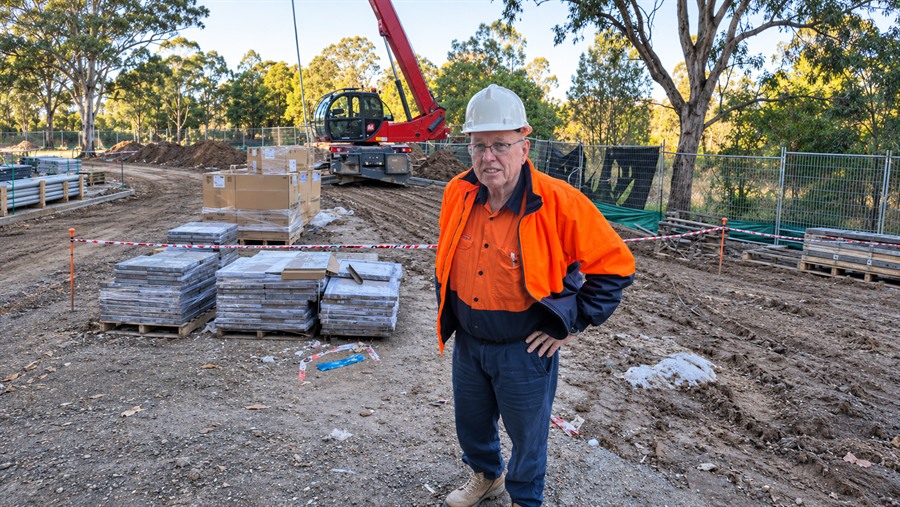
Astute Safety Mentors: experience you can’t get from a textbook
Today Jim runs Astute Safety Mentors, a workplace health and safety consultancy working with businesses across the Illawarra, Sydney and the Central Coast. He backs his hands-on experience with formal credentials and insurance.
His work covers the practical end of WHS: site safety inspections and audits, guarding audits, Safe Work Method Statements (SWMS), site traffic management plans, emergency planning, and WHS management systems built around how a business actually operates. He also helps businesses gain ISO accreditation (ISO 45001, 9001 and 14001) so they can tender for larger government and commercial contracts, and supports owners who’ve been issued a SafeWork NSW improvement notice and aren’t sure where to start.
What sets him apart, he says, is that he’s done the job. Many of his clients are builders, manufacturers and tradies who are brilliant at their craft but find WHS obligations overwhelming. Jim speaks their language because he spent his career in it.
“Wear appropriate PPE” isn’t an instruction
Jim is blunt about where many workplaces go wrong. He recently reviewed a SWMS that simply said: wear appropriate PPE.
“Appropriate according to whom?” he asks. Safety glasses or a face shield? Cut-resistant gloves? Hearing or respiratory protection? Vague instructions, he says, set workers up to fail… and that’s a management problem, not a worker problem.
“Management has a responsibility to make it easy for workers to do a good job,” Jim says. That means fit-for-purpose tools, clear procedures, enough time to do the task properly, real competency checks rather than just training attendance, and supervisors who are out on the floor rather than stuck behind a desk.
It’s a theme he returns to often. Early in his career he took over a section where supervisors spent at least half their day in the office doing production scheduling. He moved that task to a trained operator, freeing the supervisors to supervise. The most vocal objector later admitted it was the best thing they’d ever done.
Listen to the people doing the work
One of Jim’s favourite stories involves a production area where forklifts, vehicles and pedestrians were constantly crossing paths. His team had spent weeks on a solution involving fences and boom gates, and Jim still wasn’t happy with it.
Standing in the area for one last look, an operator wandered over, heard the plan and said, “That’s stupid.” Then he pointed out how to rearrange two workstations and run the road along the north wall. In under a minute he’d solved the problem and as the idea developed, it fixed several working-at-heights and storage issues too.
“Workers often know what the problems are before management does,” Jim says. “Quite often, they have already come up with practical, workable solutions.” Real consultation, in his view, means involving the people who do the work, not announcing what’s already been decided.
Built on trust and word of mouth
Most of Jim’s work comes through referrals, and that says a lot. One safety manager has brought Jim in to help at three different companies as he’s moved through his career and has passed his name on to three other safety managers.
Jim believes that’s because trust is everything in this field. Businesses want someone they know will deliver. “If you get the door open and do a good job, they don’t go anywhere else.”
A mindset, not a slogan
Jim still stands by a phrase some in the industry now question: all injuries are preventable. He doesn’t take it to mean that no one will ever be hurt. He takes it to mean that every injury can be prevented in principle, with the right planning, controls and behaviours, and that a strong safety culture keeps asking what more can be done, rather than shrugging that accidents happen.
It’s the same mindset he took onto the steelworks floor four decades ago, and the one he now brings to workshops, factories and construction sites across the region.
To find out more about Jim’s services, or to get in touch, visit Astute Safety Mentors on The List.